
FAA Says L3Harris Owns the Network Involved in the Nationwide Ground Stop
Router traffic destabilized communications at 17 of 22 en-route centers. L3Harris says the copper-to-fiber conversion is more than 70% complete; the initiating fault remains unknown.
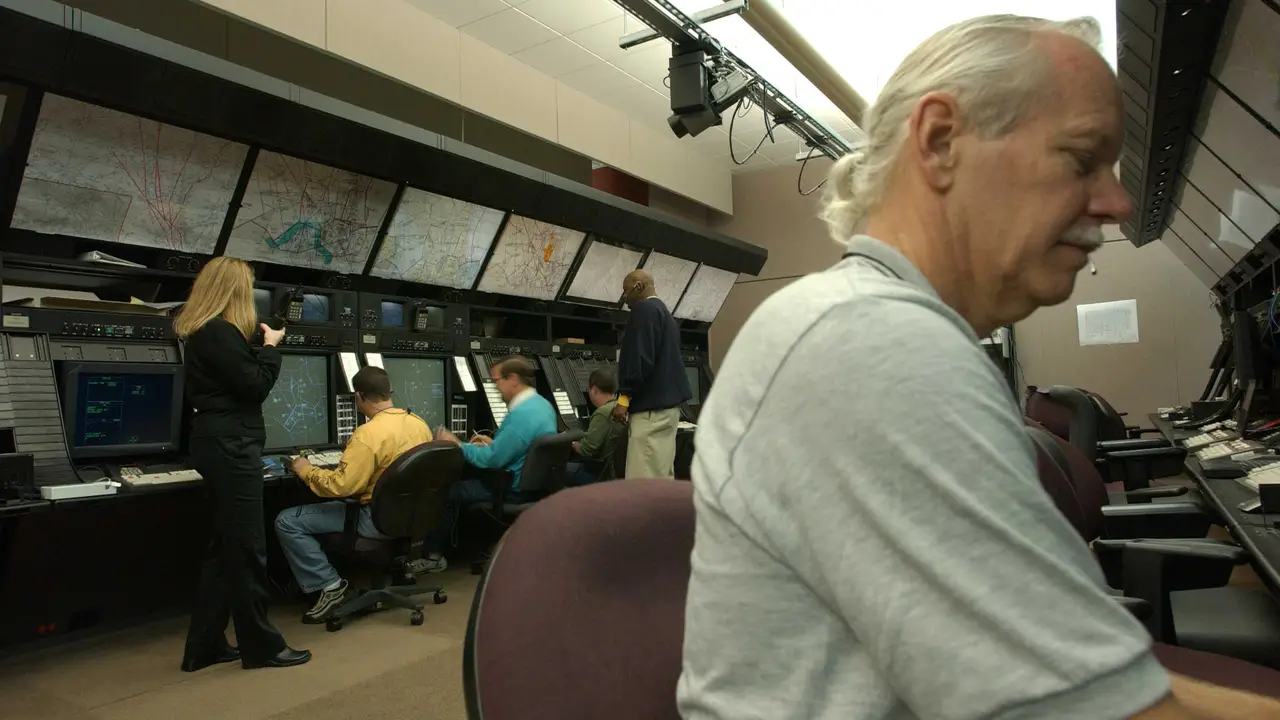
Transportation Secretary Sean Duffy and Federal Aviation Administration chief Bryan Bedford said Saturday that Friday’s nationwide ground stop began during routine work at at least one remote FAA site where contractor L3Harris was moving a telecommunications connection from copper to fiber. Duffy said L3Harris has worked for FAA for more than 20 years and owns the network FAA uses to control the airspace.
Duffy said a router involved in the work began flooding other FAA routers with more than 1,000 connection attempts every four to five seconds. Reuters reported that the instability reached 17 of FAA’s 22 en-route centers, affecting communications with aircraft and some radar feeds. Officials said isolating the maintenance work brought the systems back online.
Reuters described a nearly five-hour shutdown and reported that more than 20,000 flights had been disrupted since Friday. Those are Reuters’ reported impact figures, not a final FAA audit. DOT said 3,500 aircraft were airborne when the stop began and more than 8,000 flight operations resumed after it was lifted.
L3Harris responded Saturday that it, its telecommunications partners and FAA have completed more than 70% of the planned airspace-communications conversion from legacy copper wires to fiber. The company said it takes the disruption seriously and is supporting the investigation. Its statement did not identify the initiating fault or admit responsibility.
The formal FAA record says Advisory 005 cancelled the nationwide stop at 8:19 p.m. Eastern Friday. Duffy separately said the airspace reopened at 8:15 p.m.; the advisory supplies the authoritative cancellation time.
The new record sharpens the accountability question. According to Duffy, a private contractor owns the national telecommunications network involved, and routine work at at least one remote site propagated instability across most en-route centers. FAA should explain what contract, supervision and technical controls govern a vendor-owned safety-critical network.
That explanation should include the change-control plan, predeployment testing, network segmentation and rate limiting, rollback procedure, redundant paths, failover performance, contractor oversight and any outage penalties. FAA should also publish the final root-cause analysis and corrective actions.
There is material contrary evidence. The copper line was being discontinued, so the migration was necessary; systems recovered after FAA isolated the work; officials found no evidence of a cyberattack; and L3Harris reports substantial conversion progress. Investigators still have not determined whether installer or user error, a faulty router or another technical failure initiated the flooding.
The network has a documented earlier national failure. A June 2010 Transportation Department inspector general review said a November 19, 2009 FAA Telecommunications Infrastructure outage grounded hundreds of flights and delayed thousands of travelers.
The inspector general found that contractor network-configuration and procedural errors caused the 2009 outage, blocked about 75% of FTI traffic and delayed restoration for five hours. It also found that FAA oversight could have been more effective and proactive. Those findings are an oversight precedent, not evidence that the same errors caused the 2026 event.
The 2010 review also said FAA and Harris retired the precise legacy-network/router design involved, repaired the alerting problem and took corrective actions. FAA’s panel recommended automated router configuration and independent verification, testing changes on a model network, better end-to-end monitoring, and staffing and incentive reviews. Those records do not show that these controls failed in 2026. Separately, a September 2022 SAM.gov notice shows FAA then intended a single-source extension of the L3Harris FTI contract for continuity; it does not establish current terms or prove that no later competition occurred.
Bedford also said this routine replacement on the legacy telecommunications network was not part of the Peraton-FAA $12.5 billion modernization effort. DOT separately said it has replaced 69% of copper communications under its broader modernization work, while L3Harris’s statement describes more than 70% completion of its planned airspace-communications conversion. Those are different claims and should not be merged.
The broader governance context still matters without proving that the Brand New Air Traffic Control System caused the outage. The Government Accountability Office found that FAA lacks a comprehensive documented lifecycle cost estimate and an integrated phase-one master schedule for that initiative, and counted 11,389 project schedules that were not integrated.
The strongest supported criticism is not that L3Harris negligence, copper wiring or the modernization program has been proved as the root cause. It is that routine work on a vendor-owned national safety network propagated instability to 17 of 22 centers while key technical, contractual and supervisory controls remain undisclosed. The final incident record should show how FAA will prevent one maintenance event from again becoming a national shutdown.
The evidence record
Source claimDOT says the work occurred at at least one remote site, L3Harris has served FAA for more than 20 years and owns the network used to control the airspace.
Article paragraph: 1
Source claimDuffy described more than 1,000 connection attempts every four to five seconds; Reuters reported communications effects at 17 of 22 en-route centers.
Article paragraph: 2
Source claimReuters reported a nearly five-hour shutdown and more than 20,000 disrupted flights since Friday.
Article paragraph: 3
Source claimDOT reported 3,500 airborne aircraft at the stop and more than 8,000 resumed flight operations after it was lifted.
Article paragraph: 3
Source claimL3Harris says more than 70% of its planned airspace-communications conversion is complete and it is supporting the investigation, without identifying the fault or admitting responsibility.
Article paragraph: 4
Source claimFAA Advisory 005 cancelled the stop at 8:19 p.m. Eastern.
Article paragraph: 5
AnalysisVendor ownership and national propagation raise accountability questions about contracts, supervision, segmentation, rollback and failover.
Article paragraphs: 6, 7
Source claimThe migration was necessary, isolation restored service, no cyber cause is believed and the initiating fault remains unresolved.
Article paragraph: 8
Source claimL3Harris reports substantial conversion progress.
Article paragraph: 8
Source claimBedford said this work was separate from BNATCS; DOT's 69% and L3Harris's more-than-70% figures describe different stated scopes.
Article paragraph: 12
Source claimGAO found no comprehensive lifecycle estimate, no integrated phase-one schedule and 11,389 unintegrated schedules for BNATCS.
Article paragraph: 13
AnalysisThe strongest criticism concerns undisclosed controls on a vendor-owned national network, not a proved negligence or modernization-causation finding.
Article paragraph: 14
Source claimDOT OIG says the Nov. 19, 2009 FTI outage grounded hundreds of flights and delayed thousands of travelers.
Article paragraph: 9
Source claimDOT OIG found contractor configuration and procedural errors caused the 2009 outage, blocked about 75% of FTI traffic, delayed restoration five hours and exposed FAA oversight that could have been more effective and proactive.
Article paragraph: 10
Source claimA 2022 SAM notice documented FAA's intent at that time to extend the L3Harris FTI contract on a single-source basis for continuity, without establishing current contract terms or later competition.
Article paragraph: 11
Source claimDOT OIG said FAA and Harris retired the precise legacy-network/router design involved in 2009, repaired the alerting problem and took corrective actions; this does not establish the same controls failed in 2026.
Article paragraph: 11
Source claimFAA's review panel recommended automated router configuration and independent verification, model-network testing, improved situational awareness, staffing review and incentive review.
Article paragraph: 11
Sources and access
Each source record identifies its reporting origin, access scope and the date we checked it.
DOT update on restoration following the nationwide ground stop
U.S. Department of Transportation · Checked November 14, 2026
- Recorded relationship
- original
- Origin
- U.S. Department of Transportation
- Access
- Full text
- Locator
- Nov. 14 briefing lines 19–58: network ownership attribution, router flood, safety response, modernization percentages, BNATCS distinction and work-timing review
- Source publication
- November 14, 2026
L3Harris statement on the Nov. 13 ground stop
L3Harris Technologies · Checked November 14, 2026
- Recorded relationship
- original
- Origin
- L3Harris Technologies
- Access
- Full text
- Locator
- Nov. 14 corporate statement lines 7–11: conversion progress and support for investigation
- Source publication
- November 14, 2026
US aviation shutdown blamed on L3 Harris installed router
Reuters · Checked November 14, 2026
- Recorded relationship
- original
- Origin
- Reuters
- Access
- Full text
- Locator
- Nov. 14 report lines 153–200: duration, flight disruption estimate, 17 of 22 centers, fault uncertainty, L3Harris response and legacy-network context
- Source publication
- November 14, 2026
FAA Advisory 005 — Cancellation of Nationwide Ground Stop
Federal Aviation Administration · Checked November 14, 2026
- Recorded relationship
- original
- Origin
- Federal Aviation Administration
- Access
- Full text
- Locator
- Cancellation signed 01:19Z Nov. 14; effective time 01:19–02:00Z
- Source publication
- November 14, 2026
Air Traffic Control Systems: Ambitious New Modernization Effort Needs to Improve Cost and Schedule Planning
U.S. Government Accountability Office · Checked November 14, 2026
- Recorded relationship
- original
- Origin
- U.S. Government Accountability Office
- Access
- Full text
- Locator
- Lifecycle-cost omissions, 11,389 unintegrated schedules and open recommendations
- Source publication
- September 14, 2026
Letter to Chairmen Oberstar and Costello Regarding the 2009 FAA Telecommunications Infrastructure Outage
U.S. Department of Transportation Office of Inspector General · Checked November 15, 2026
- Recorded relationship
- original
- Origin
- U.S. Department of Transportation Office of Inspector General
- Access
- Full text
- Locator
- June 17, 2010 correspondence summary, paragraphs identifying cause, impact, corrective actions and FAA oversight findings
- Source publication
- June 17, 2010
FAA Telecommunications Infrastructure contract extension notice
SAM.gov / Federal Aviation Administration · Checked November 15, 2026
- Recorded relationship
- original
- Origin
- Federal Aviation Administration
- Access
- Full text
- Locator
- September 30, 2022 special notice describing an intended single-source extension of DTFA01-02-D-03006 for service continuity
- Source publication
- September 30, 2022
FAA Telecommunications Infrastructure Review Panel Report on the November 19, 2009 Outage
Federal Aviation Administration · Checked November 15, 2026
- Recorded relationship
- original
- Origin
- Federal Aviation Administration
- Access
- Full text
- Locator
- Phase I findings and recommendations on router configuration, independent verification, model-network testing, monitoring, staffing and contract incentives
- Source publication
- May 28, 2010
Prepared with AI research and writing tools. Sources and evidence are listed below. Public Rot is responsible for the published account.
Revision record
Revision 1 · November 13, 2026
Initial publication.
Revision 2 · November 13, 2026
Updated after the FAA lifted the nationwide ground stop: departures can resume, at least 827 flights had been diverted as of 7:05 p.m. Eastern, and the technical cause remains under investigation. The revision distinguishes scheduled exposure from confirmed impacts and preserves the original publication date.
Revision 3 · November 13, 2026
Corrected an omission introduced in revision 2 by restoring the paragraph that directly states GAO’s findings: FAA lacks a comprehensive documented lifecycle cost estimate and an integrated phase-one master schedule. The live-event update and original publication date are unchanged.
Revision 4 · November 14, 2026
Updated November 14 with FAA and Transportation officials’ new preliminary account: the disruption propagated during L3Harris copper-to-fiber maintenance at a remote site, the national stop was formally cancelled at 8:19 p.m. Eastern, and investigators have not determined whether installer error or defective equipment initiated the router flooding. The original November 13 publication date is preserved.
Revision 5 · November 14, 2026
Headline updated to emphasize the article’s supported finding; reporting and original publication date unchanged.
Revision 6 · November 14, 2026
Updated with the Nov. 14 DOT briefing and L3Harris response: DOT says L3Harris owns the FAA telecommunications network involved and has served as its legacy provider for more than 20 years; L3Harris says more than 70% of its planned copper-to-fiber conversion is complete. The revision adds Reuters’ attributed impact figures, distinguishes the legacy-network work from BNATCS, removes the stale no-response statement and preserves the unresolved root-cause limit. The original publication date is unchanged.
Revision 7 · November 15, 2026
Added the documented 2009 FAA Telecommunications Infrastructure outage as a qualified oversight precedent and the 2022 planned contract-extension record. The update states the earlier contractor configuration findings and FAA oversight criticism while also recording the corrective actions that retired the precise 2009 failure design, the panel’s control recommendations, and the limits of applying either record to the still-unresolved 2026 cause. The original publication date, headline and image are unchanged.
These are the recorded publication notices. Open reader tools, full available revisions or report a possible error →